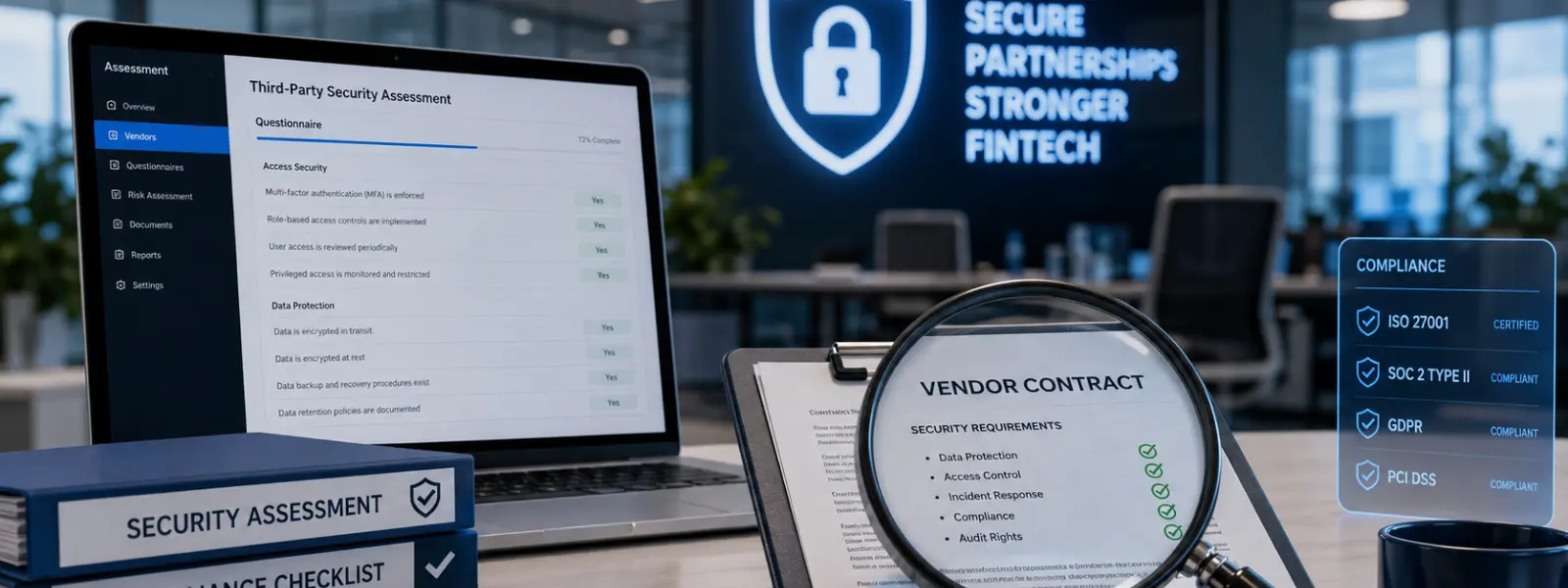
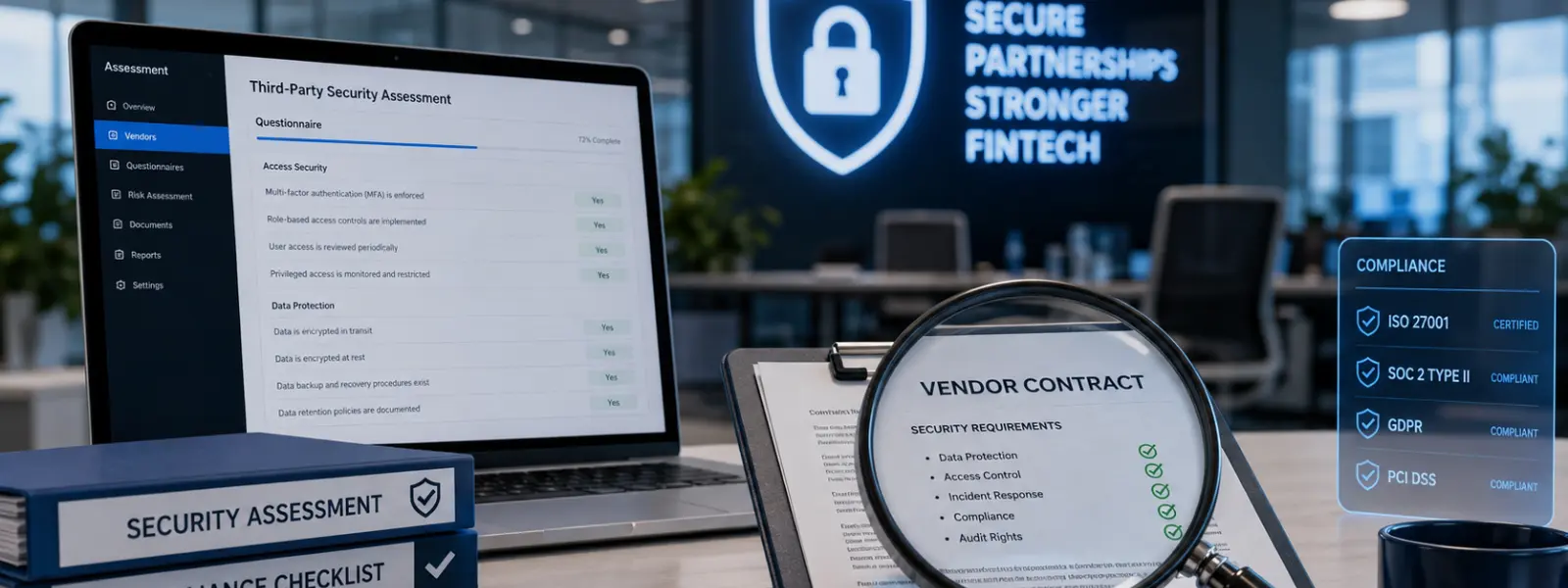
Enterprise customers, sponsor banks, and regulators all assess fintechs as third-party vendors before entering or continuing a relationship. Understanding what they are looking for, how these assessments are structured, and what gaps most commonly surface is the starting point for building a security program that passes scrutiny.
The fintechs that move through third-party risk assessments efficiently are not the ones with the most sophisticated security stacks. They are the ones whose security program documentation reflects how the company actually operates and whose evidence package was built continuously, not assembled the week the questionnaire arrived.
This article covers what assessors actually evaluate, the documentation they expect, and the gaps that most commonly slow or block relationships with enterprise customers and sponsor banks.
Why Third-Party Risk Assessments Have Gotten More Rigorous
Regulators, including the OCC, FDIC, Federal Reserve, and NYDFS, have issued guidance making it clear that financial institutions are responsible for the security and compliance posture of the third-party vendors they work with. NYDFS Part 500 requires covered entities to contractually require their vendors to maintain appropriate security controls. The GLBA Safeguards Rule requires covered financial institutions to oversee their service providers. The NCUA examination framework requires credit unions to conduct vendor risk assessments.
The consequence for fintechs is direct. Enterprise customers and sponsor banks that once relied on a fintech's self-attestation are now conducting structured third-party risk assessments with defined documentation requirements. Fintechs that cannot provide credible evidence of a functioning security program are finding that deals stall or fail to close.
A fintech's security posture now determines its ability to secure and maintain critical enterprise and banking relationships. This has moved from a compliance consideration to a direct business risk.
What Assessors Are Actually Evaluating
Third-party risk assessments typically concentrate on five areas. Understanding what assessors are looking for in each area is the starting point for preparing effectively.
1. Information Security Program Documentation
Assessors want to see a written, board-approved, or executive-approved information security policy that is current, specific to your environment, and actually followed by your team. Generic templates downloaded from the internet are easy to spot. Policies that reference systems you no longer use, or that do not address cloud environments and remote access, will generate findings. Assessors also look for evidence that the policy is reviewed at least annually and that the review is documented.
2. Incident Response and Security Controls
Your incident response plan needs to be more than a written document. Assessors expect to see evidence that it has been tested through tabletop exercises and that your team knows their roles. They will also assess whether your technical controls are consistent with your stated security posture. Gaps between what your policy says and what your controls actually implement are a common finding.
3. Access Controls and Authentication
Multi-factor authentication, least-privilege access, and a documented process for revoking access when employees leave are standard areas of focus in every third-party risk assessment. Fintechs that built access informally during the product development phase and have never formally cleaned it up consistently generate findings here.
4. Third-Party and Supply Chain Oversight
Every vendor you use that has access to your systems or your customer data is a potential risk vector that your assessor is also exposed to through you. Assessors expect to see a formal vendor risk management program that includes initial due diligence before onboarding, annual security reviews of critical vendors, contractual security requirements, and documented exit strategies. Most early-stage fintechs have a vendor list. Few have a genuine vendor risk management program.
5. Governance and Reporting
Assessors evaluate whether security and compliance have meaningful executive oversight. This means documented evidence that security is reported to senior leadership on a regular cadence and that there is clear accountability for the security program. If security is purely an engineering function with no executive visibility, that will be a finding.
The Documentation Package That Passes Scrutiny
The fintechs that move through third-party risk assessments most efficiently are prepared with a standing documentation package that they can produce on request. This package typically includes a current information security policy with evidence of annual review, a risk register that documents identified risks and mitigating controls, an incident response plan with evidence of tabletop testing, a vendor inventory with risk tier ratings and recent review evidence, and a current security report addressed to executive leadership.
Building this package is not a one-time project. It is an ongoing operational discipline. Evidence that was collected three months ago is more credible than evidence assembled last week because it demonstrates that your controls are actually running, not turned on for the assessment.
The Most Common Gaps That Slow Assessments
Policies that do not match operations. The most common finding across every assessment type is a gap between what the policy documents say and how the organization actually operates. Assessors test this by asking for evidence of control operation, not just the policy itself.
No documented vendor risk management. Fintechs routinely have 20 to 40 SaaS and infrastructure vendors with access to customer data and have never formally assessed a single one. Assessors notice this immediately.
Incident response plans that have never been tested. A written plan satisfies a documentation check. A tested plan demonstrates operational readiness. The difference matters to an experienced assessor.
No designated security leader. Assessors expect to see a named individual responsible for the security program, whether full-time, part-time, or fractional. A program with no designated owner has no accountability structure that an assessor can evaluate.
How to Prepare Before the Assessment Arrives
The single most effective preparation for a third-party risk assessment is building your security program as if you were already being assessed. That means current policies that reflect current operations, ongoing evidence collection, regular vendor reviews, annual policy reviews documented with approval records, and regular security reporting to leadership.
Fintechs that build this way pass assessments efficiently because there is nothing to scramble to produce. The evidence exists because the controls were running.
For fintechs that are not yet there, a security program gap assessment is the starting point. It maps your current posture against what third-party risk assessors expects, identifies the specific gaps, and produces a prioritized remediation roadmap with realistic timelines.