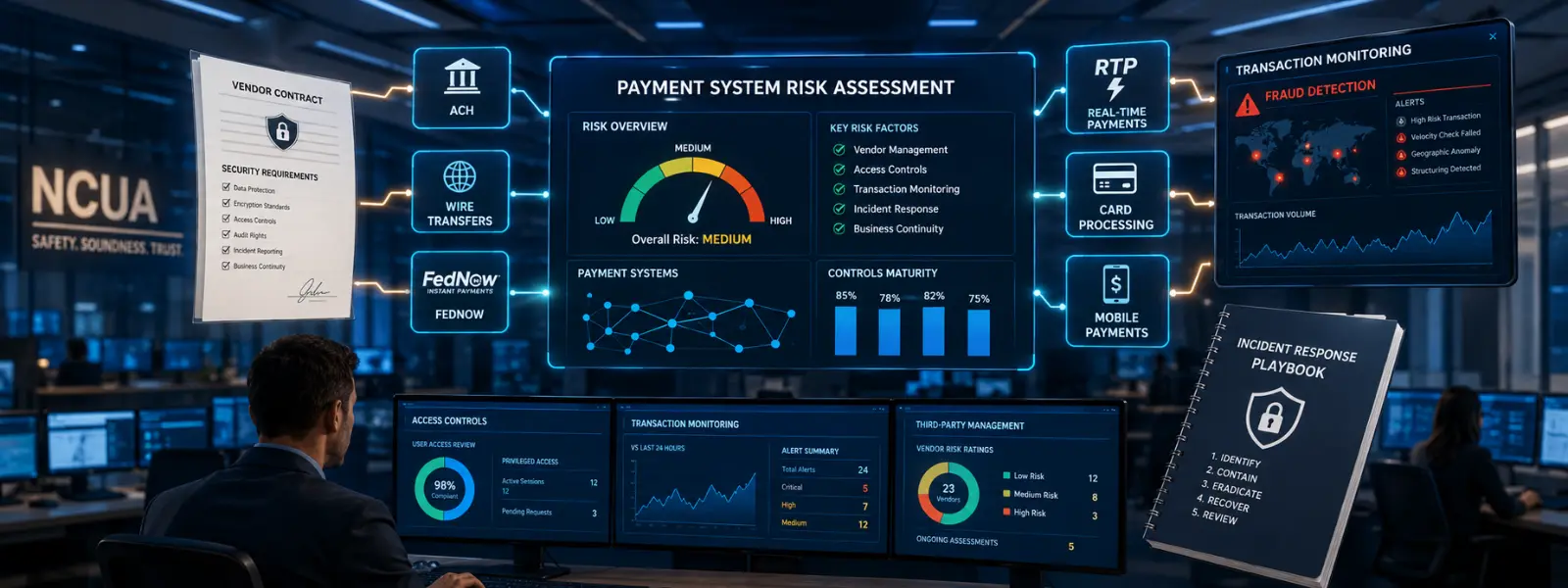
The NCUA's 2026 Supervisory Priorities letter explicitly identified payment systems as a key operational risk area for the year. This is not a new concern for credit unions, but the specificity of what examiners are now assessing has increased significantly. Credit unions that have a current risk assessment for their core processing platform but nothing documented for their real-time payments provider or ACH vendor are likely to receive a finding.
As payment environments grow more complex, with real-time payment rails expanding, digital wallet integrations multiplying, and third-party payment processors handling increasingly critical functions, the attack surface and the regulatory scrutiny have both expanded. Understanding exactly what examiners are looking for is the starting point for preparing.
Why Payment Systems Are Under More Scrutiny in 2026
The NCUA's 2025 Cybersecurity and Credit Union System Resilience Annual Report to Congress documented specific incident categories affecting payment systems, including ATM jackpotting, fraudulently induced payments, and business email compromise targeting payment authorization. These are not hypothetical risks. They are documented incident types that occurred at federally insured credit unions during the reporting period.
The expansion of real-time payment infrastructure has also created new risk vectors. FedNow and RTP transactions are irreversible once completed, meaning fraud detection and authorization controls need to work correctly the first time. The tolerance for gaps in controls around real-time payments is lower than for legacy payment rails where there was more time to identify and reverse fraudulent transactions.
What Examiners Are Specifically Assessing
Risk Assessments for Each Payment System
Examiners are looking for current risk assessments that address each payment system the credit union uses, not just the core processing platform. This means separate documentation for ACH origination and receipt, wire transfers, real-time payments through FedNow or RTP, card processing, ATM networks, and mobile and digital payment channels. A single consolidated risk assessment that treats all payment systems generically will not satisfy examiner expectations.
Vendor Management Documentation for Payment Processors
Many credit unions have strong vendor risk management programs for their core processor but have not extended the same rigor to their payment processors, card networks, and real-time payment providers. Examiners in 2026 are specifically looking at whether vendor risk assessments exist for payment system vendors, whether contractual security requirements are in place, and whether annual reviews have been conducted.
Transaction Monitoring and Fraud Controls
Examiners assess whether transaction monitoring controls are appropriately calibrated for the payment systems in use and whether they are actually detecting anomalous activity. Controls that exist on paper but are not tuned to the credit union's actual transaction patterns and risk profile provide documentation compliance without operational protection.
Incident Response for Payment Disruptions
The NCUA expects incident response procedures to specifically address payment system disruptions, not just general cybersecurity incidents. This includes procedures for what happens when a payment system is unavailable due to a cyber incident at a vendor, how member communications are handled, and how the 72-hour NCUA reporting obligation is triggered for payment-related incidents.
The NCUA's 2026 priorities explicitly call out payment systems as a key risk area. Examiners will look beyond your internal controls. They will assess the vendor management and risk assessment documentation for your payment processors specifically. Having a risk assessment for your core processor but nothing for your ACH vendor or real-time payments provider is a finding waiting to happen.
The BSA and AML Intersection
Payment system security in 2026 also intersects with the NCUA's BSA and AML priorities. A cyber incident resulting in fraudulent payments , whether through account takeover, business email compromise, or ATM jackpotting , may trigger SAR filing requirements under the Bank Secrecy Act in addition to the 72-hour NCUA cyber incident reporting obligation. Credit unions need to ensure their fraud response procedures and their cybersecurity incident response procedures are coordinated, not siloed.
How to Prepare Before Your Examination
Credit unions preparing for an NCUA examination should conduct a specific inventory of all payment systems in use and verify that each one has a current risk assessment on file. Review vendor contracts for all payment processors and verify that security requirements, breach notification obligations, and audit rights are documented. Test your incident response procedures specifically against a payment system outage scenario. And verify that your transaction monitoring controls have been reviewed and calibrated within the past 12 months.
The credit unions that perform well in payment system examinations are not necessarily the ones with the most sophisticated payment infrastructure. They are the ones that have documented their risk assessment process, their vendor oversight activities, and their monitoring controls in a way that an examiner can verify independently.