CIRCIA's Final Rule Is at the White House. Here Is What Your NCUA and NYDFS Reporting Will Not Cover on Day One
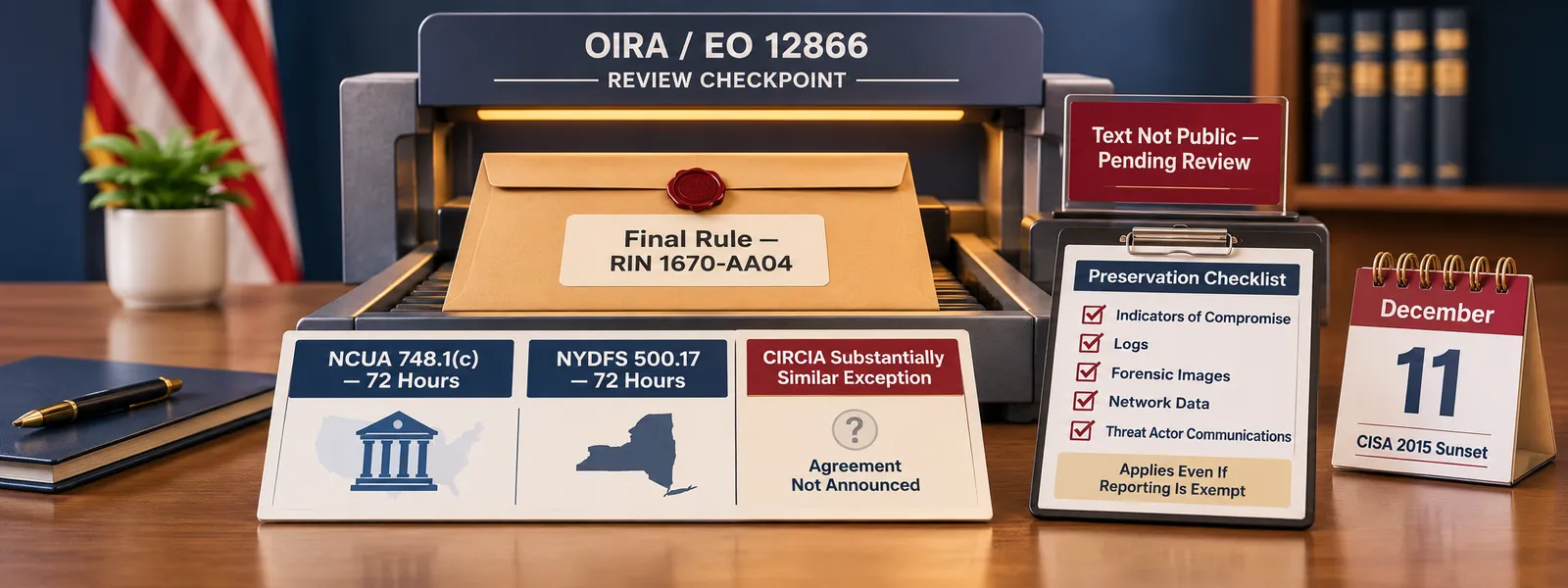
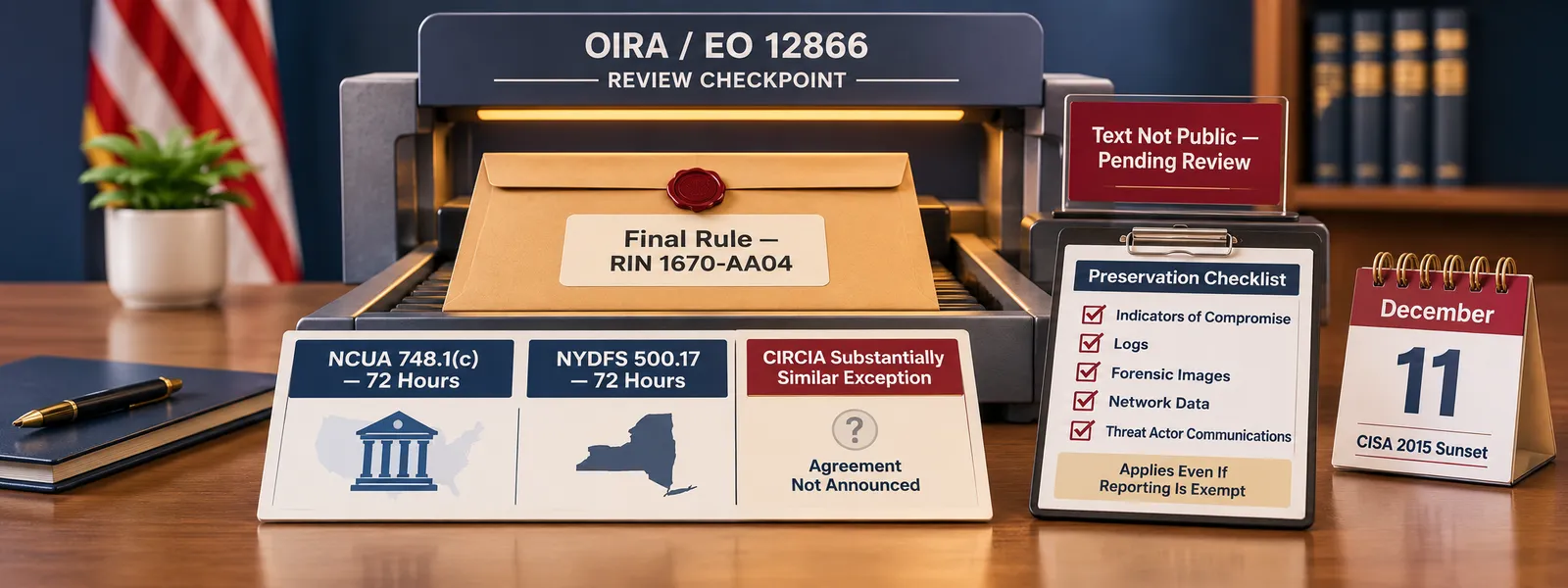
On October 1, 2026, CISA sent its final rule implementing the Cyber Incident Reporting for Critical Infrastructure Act to the Office of Management and Budget. The reginfo.gov record for RIN 1670-AA04 lists the stage as Final Rule, received October 1, and the status as pending review under Executive Order 12866.
The text is not public. Nobody outside the government can tell you what the final rule says.
An attorney quoted by BankInfoSecurity expects publication before the end of the year. That is a forecast, not a date.
Nothing is reportable under CIRCIA until the final rule takes effect. CISA has said so directly. But the rule is now closer than it has been since the proposal published in April 2024, and a few things are worth settling before it lands.
Where things stand
CISA missed the statutory deadline, which fell 18 months after the April 2024 proposal. It also missed target dates of May 2026 and September 2026.
The review stage matters. OIRA review typically comes near the end of a rulemaking. A final rule can still change during review, and the review period has no fixed length.
National Cyber Director Sean Cairncross said in late September that attention has gone into harmonizing the reporting structure and fitting the final rules to requirements already in place. Treat that as a signal about intent, not as a description of the text.
The statute fixes two things the final rule cannot change. A covered entity reports a covered cyber incident within 72 hours of reasonably believing it occurred. A ransom payment is reported within 24 hours of disbursement.
Everything else, including who is covered, what counts as a covered incident, and how the substantially similar reporting exception works, depends on the final text.
What your existing reporting will not do
If you already report incidents to NCUA under 12 CFR 748.1(c) or to NYDFS under 23 NYCRR 500.17, it is natural to assume CIRCIA will not add much. That assumption may turn out right. It is not right yet.
The exception needs an agreement
The statute allows an exception when an entity is required by law, regulation, or contract to report substantially similar information to another federal agency in a substantially similar timeframe. Under the 2024 proposal, the exception also required CISA and that agency to have an information-sharing mechanism and a written agreement in place.
CISA has not announced any such agreement. When the rule publishes, look for whether CISA names agreements with NCUA, the banking agencies, or others, and whether they take effect on the same date as the rule.
NYDFS is a state agency
The statutory exception refers to reporting to a federal agency. NYDFS reporting, however prompt, sits outside that language as written. Whether the final rule offers any path for state reporting is unknown.
Preservation was separate from reporting
Under the 2024 proposal, the data preservation requirement applied even to entities that qualified for the reporting exception. Preservation covered indicators of compromise, relevant logs, forensic artifacts including memory captures and images, network data, and communications with the threat actor, for two years past the last report.
If the final rule keeps that structure, an exemption from reporting would not be an exemption from preserving.
Your vendors hold much of the evidence
Many of the artifacts on that preservation list sit with third parties: managed security providers, cloud platforms, core processors, and SaaS vendors. Their default log retention may be measured in days or weeks, not years. Recent vendor incidents in this sector, including outages at software providers serving banks and credit unions, have shown how much of the record lives outside the institution. Whether your contracts give you the right to require preservation, and at whose cost, is a question to answer before the rule publishes rather than during an incident.
Publication is not day one. The effective date will come later, and the substantially similar exception may depend on agreements that do not exist yet. Do the work that holds its value under any version of the rule: decide whether you are likely in scope, and make sure you can preserve what an investigation needs.
A second deadline on December 11
The Cybersecurity Information Sharing Act of 2015 provides liability, antitrust, and disclosure protections for sharing cyber threat indicators. Its sunset sits at December 11, 2026, after Division B, section 2011 of Public Law 119-103 moved it there from September 30.
The law has lapsed twice since October 2025. In November, industry groups urged Congress to extend it through the annual defense authorization bill, according to Nextgov. Long-term reauthorization has not passed as of this writing.
If those protections lapse again while a CIRCIA final rule is publishing, you may face a period where incident reporting expectations rise and threat-sharing protections fall at the same time.
What to do
Run the scope test under the 2024 proposal now, and write down the answer. Note which criterion you rely on: the SBA size standard for your industry, or a sector criterion. Expect to redo it against the final text.
Map your current reporting obligations side by side: NCUA, your banking regulator, NYDFS, SEC, card brands, and contracts. Record each trigger and clock. That map is what you will compare against the final rule's exception language.
Build preservation capability. Confirm you retain logs, can capture memory and images, and can hold threat-actor communications. Check whether your vendors would preserve on your behalf, and for how long.
Leave reporting workflows alone until the text publishes. Scope and the exception are the parts most likely to change, and workflows built on proposed text risk rework.
Track December 11 for CISA 2015. If you share through FS-ISAC or directly with federal partners, ask counsel how a lapse would affect what you share.
Watch the primary record. Track RIN 1670-AA04 on reginfo.gov and the Federal Register rather than trade press.
SOURCE: Office of Information and Regulatory Affairs, Pending EO 12866 Regulatory Review, RIN 1670-AA04, "CIRCIA Reporting Requirements," Final Rule, received October 1, 2026. CISA, Cyber Incident Reporting for Critical Infrastructure Act Reporting Requirements, proposed rule, 89 FR 23644 (April 4, 2024). 6 U.S.C. 681b. Public Law 119-103, Division B, section 2011.
This article is provided for general information and does not constitute legal advice. Regulatory requirements, compliance dates, examiner priorities, and enforcement posture change frequently. Verify current requirements against primary agency sources and your legal counsel before acting on anything described here.