Chainalysis Says Credentials and Live Tokens for All Users Were Exposed. If You Screen Transactions With It, Rotate Now
On October 30, 2026, Chainalysis disclosed that an unidentified attacker had broken into its systems. The company said the attacker used what it called "offensive agentic techniques."
The first notice described limited exposure: user IDs, full names, email addresses, and organization role labels. Chainalysis said it had found no evidence that clear-text passwords, MFA secrets, or user session tokens were accessed.
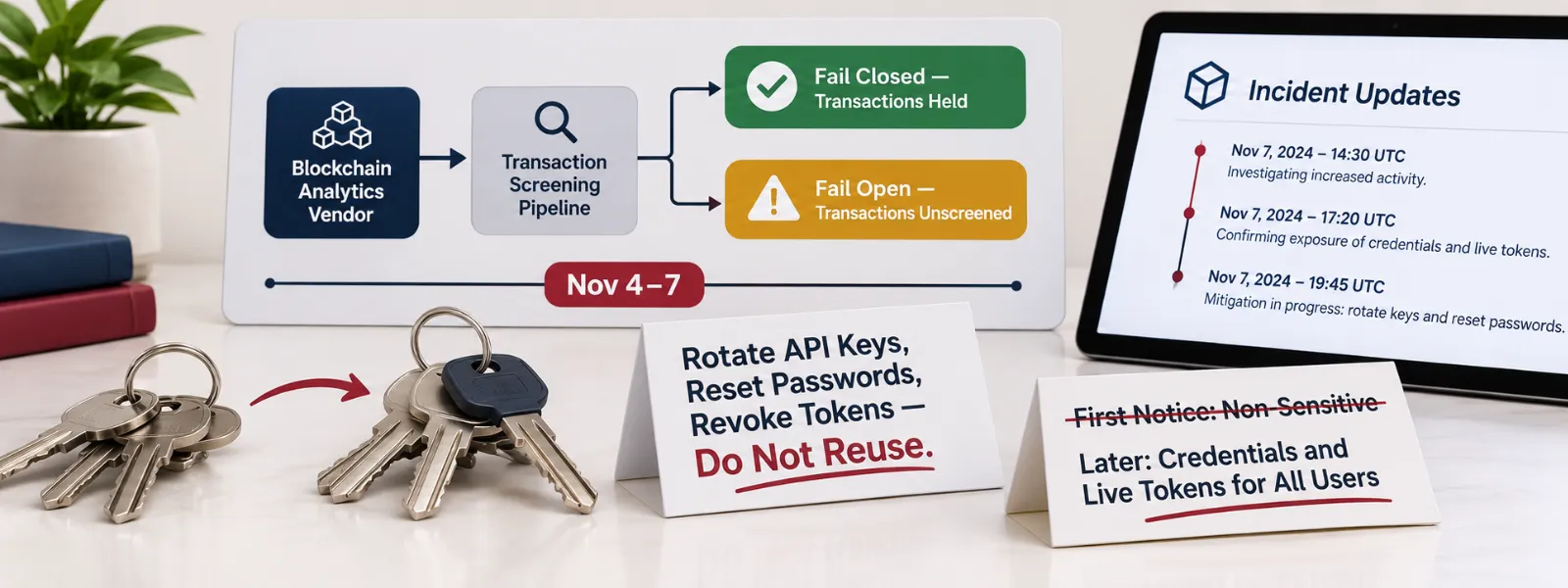
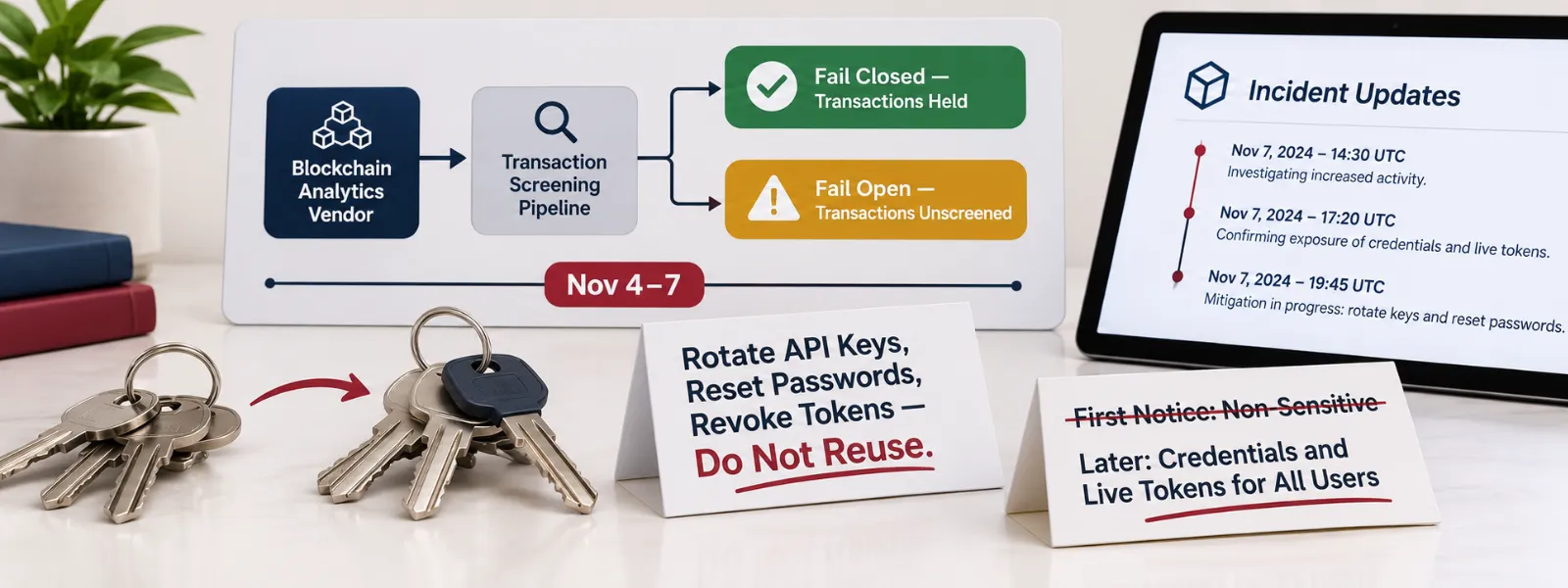
Five days later, the picture changed. On the morning of November 4, Chainalysis emailed customers about an on-path attack affecting a subset of passwords. That night, according to BleepingComputer's account of the company's updates, it confirmed that names, usernames, password hashes, and live tokens for all users had been exposed. The updates do not clearly say whether the on-path attack explains the wider exposure.
If your institution or fintech uses Chainalysis for blockchain analytics, transaction screening, or address screening, this is your vendor incident. Here is what is known, what is not, and what to do.
What Chainalysis has said
Chainalysis has published its updates on a single incident page on its blog. Trade press has quoted that page throughout. The timeline below comes from those reports.
On October 30, the notice listed non-sensitive customer data as accessed and said there was no indication that investigation content had been reached.
On November 2, broader exposure was discovered, and Reactor, Data Solutions, and Chain (Beta) were taken offline, according to Tech Insider's timeline.
On November 4, customers were emailed about an on-path attack affecting a subset of passwords. Later that morning, Chainalysis detected further abnormal activity and took KYT, Address Screening, and the login page offline. That night it confirmed exposure of credentials and live tokens for all users.
The same day, Chainalysis said it continued to have no evidence that investigations data had been accessed, and that attribution data had not been manipulated.
From November 6, customers had to send trusted IP addresses for an allowlist, then reset passwords and rotate API keys before regaining access. Phased restoration began November 6 for customers who completed those steps, and Reactor, KYT, and Address Screening were fully back on November 7. Data Solutions and Chain (Beta) remained offline as of November 8.
Chainalysis's customers include law enforcement, government agencies, financial institutions, insurers, and cryptocurrency businesses.
What is still unknown
Several facts matter to your response, and Chainalysis has not published them.
What "live tokens" covers
The updates do not say whether the exposed tokens are API keys, session tokens, or both. That distinction decides what you rotate and what you can stop worrying about.
A token that is still valid may let a holder act as a user without a password. Resetting a password does not always revoke tokens issued before the reset.
Whether anyone used the credentials
No public update says the exposed credentials or tokens were used against customer accounts. The absence of that statement is not evidence either way.
How the passwords were hashed
The hashing method has not been disclosed. Strong, salted hashing makes cracking expensive. Weak hashing does not.
What AI actually did
Chainalysis declined to explain the role of the techniques it described. Treat "agentic" as the company's description, not as an established fact about the attack.
The first notice called the exposed data non-sensitive. Five days later, it covered credentials for every user. Build your vendor incident response on the assumption that the first scope statement will grow, and act on what you control before the vendor finishes its investigation.
What a screening outage means for your program
KYT and Address Screening went offline on November 4. Phased restoration began November 6, with full return on November 7. If your payment or onboarding flow calls those services, consider what happened during that window.
Some integrations fail closed and hold transactions. Others fail open and let transactions through unscreened. You may not know which one yours does until you check.
For a bank, credit union, or money services business, transactions processed without screening may need a retrospective review against your BSA/AML program. Your own policies and your regulator's expectations decide how far back and how deep. This is an operational question before it is a compliance one.
Reporting questions
Whether this incident triggers your own reporting depends on your charter and what you find.
For a federally insured credit union, 12 CFR 748.1(c) applies to a substantial cyber incident. One of its prongs covers unauthorized access to sensitive data through a compromise of a cloud service provider or other third-party data hosting provider. Whether exposure of your users' credentials to a vendor's attacker meets that prong is a judgment you should document. The 72-hour clock can start on your reasonable belief or on vendor notice, whichever comes first.
For a bank, the federal notification rule turns on material disruption or degradation of operations. A screening outage may or may not reach that level for your institution.
For an NYDFS licensee, Part 500 has its own notice requirements. Check them against your facts.
What to do
Confirm your exposure. Identify every user, service account, and integration that authenticates to Chainalysis, including through a fourth party such as a compliance platform that embeds it.
Rotate everything Chainalysis issued to you. Reset user passwords, rotate API keys, and revoke any tokens you can revoke from your side. Do not reuse old secrets.
Check password reuse. If any user's Chainalysis password matched credentials used elsewhere in your environment, treat those as exposed too.
Review the November 4 to November 7 window. Determine whether your integration failed open or closed, and whether any transactions or onboarding decisions went through without screening.
Ask Chainalysis in writing what "live tokens" means for your account, whether your credentials were used, and when you will receive the per-client exposure report the company said it would send.
Document your reasonable-belief analysis with timestamps, whichever way it goes.
Revisit the vendor's risk tier. A blockchain analytics provider that holds credentials for your compliance staff and feeds screening decisions into your payment flow is a critical third party for most programs that use it. Rate it that way, and test what happens when it goes dark.
Re-check before acting. Chainalysis has updated its page several times, and facts may change after this was written.
SOURCE: Chainalysis, security incident notice and updates, chainalysis.com/blog/security-incident-october-30/ (October 30 to November 7, 2026), as reported by BleepingComputer (November 6, 2026), The Block (October 31, 2026), and Tech Insider (November 8, 2026). 12 CFR 748.1(c). 12 CFR Part 53.
This article is provided for general information and does not constitute legal advice. Regulatory requirements, compliance dates, examiner priorities, and enforcement posture change frequently. Verify current requirements against primary agency sources and your legal counsel before acting on anything described here.