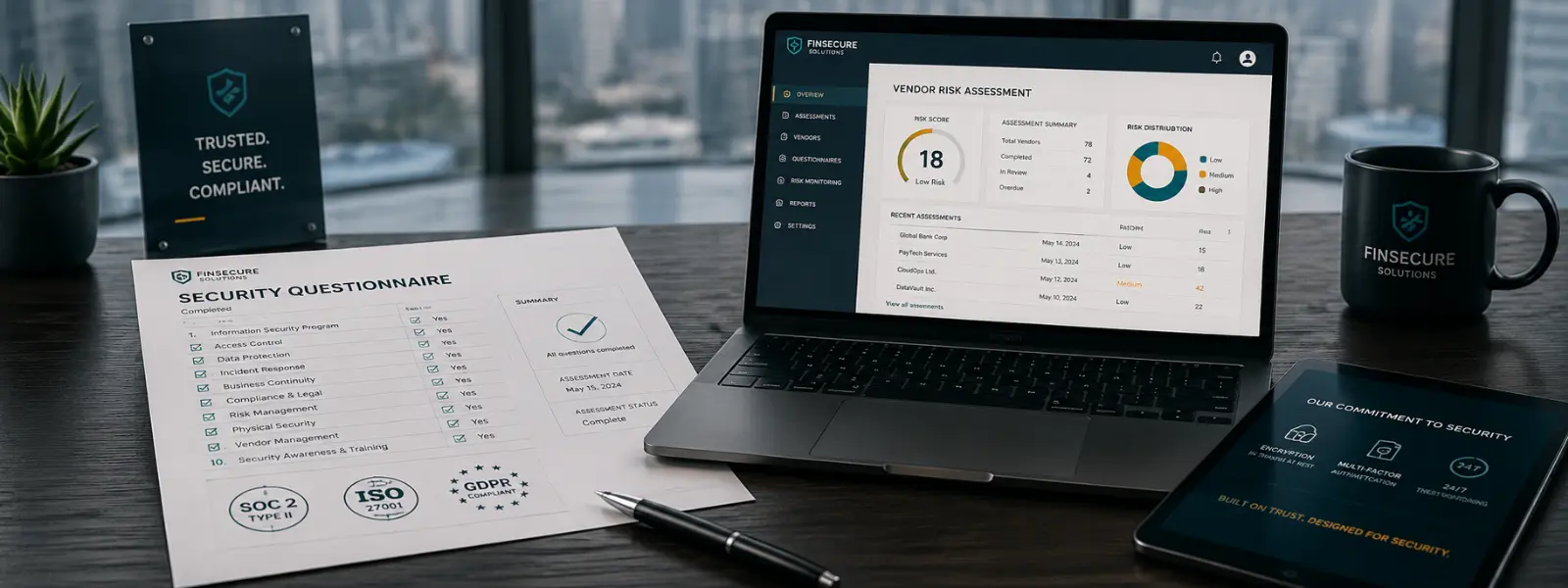
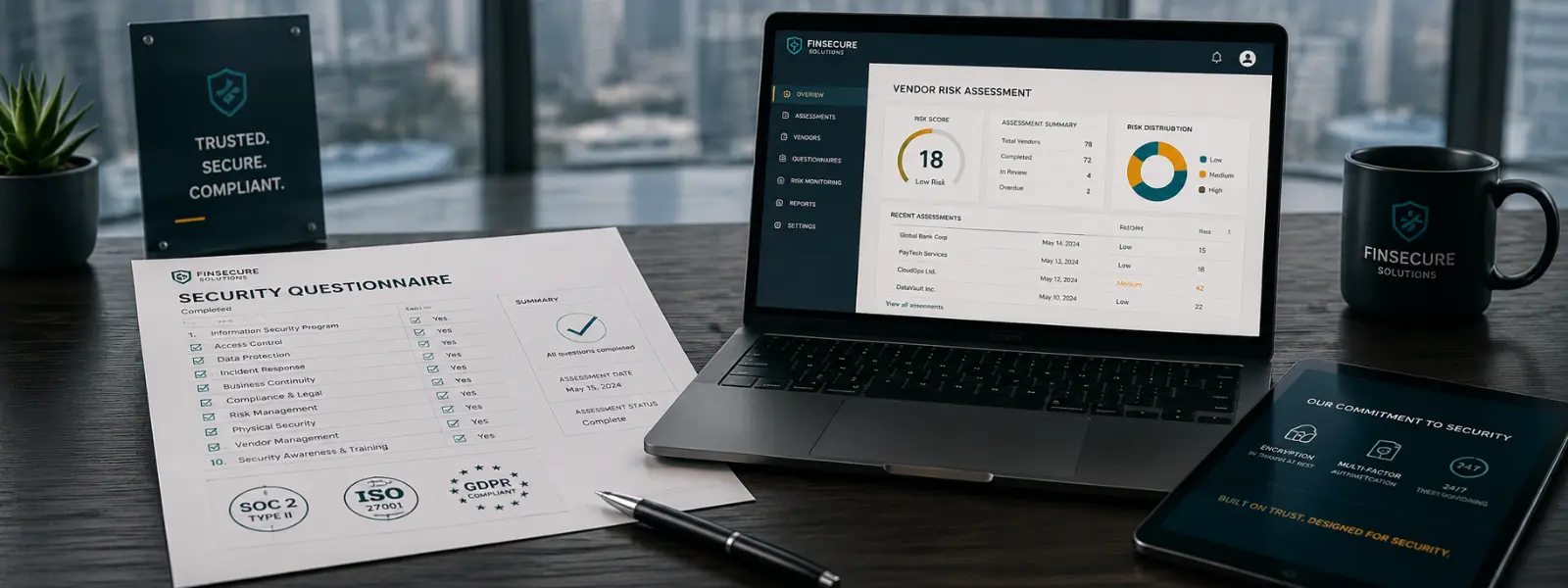
The moment your fintech starts pursuing enterprise customers, security questionnaires become a recurring fact of life. A procurement team at a bank, insurance company, or large financial services firm sends over a 150-question questionnaire about your security program, and suddenly, a deal that felt close is gated by a process you were not prepared for.
Most early-stage fintechs handle their first few security questionnaires badly - not because they have poor security, but because they have not organized their security program in a way that makes it easy to answer these questions accurately, consistently, and quickly. This guide covers what enterprise security questionnaires actually assess, how to prepare your program to answer them efficiently, and how to handle the questions that expose gaps.
What Security Questionnaires Are Actually Measuring
Enterprise security teams use questionnaires to assess two related but distinct aspects. First, they want to understand your actual security posture - what controls you have in place, how you manage risk, what your incident history looks like, and how mature your security program is. Second, they want to assess your operational credibility - whether you have thought seriously about security, whether your answers are consistent with each other, and whether you can back up your answers with evidence.
The second assessment is the one that trips up most startups. An enterprise security team that has reviewed hundreds of vendor questionnaires can spot inconsistencies between answers very quickly. A company that claims to have a formal incident response plan but cannot describe the last time it was tested raises immediate questions about whether the plan actually exists or is a document created the week the questionnaire arrived.
The Most Common Question Categories
Data Handling and Classification
Almost every questionnaire asks how you classify, store, encrypt, and control access to customer data. Specifically, what data do you collect, where is it stored, how is it encrypted at rest and in transit, who has access to it, and how do you ensure access is limited to what is necessary? These questions are straightforward if you have a data classification policy and have implemented controls accordingly. They are difficult to answer consistently if you have not.
Access Control and Authentication
Questions about who has access to which systems, how that access is managed, what multi-factor authentication is in place, and how access is revoked when employees leave are standard across all questionnaire formats. Gaps here - particularly around MFA coverage and offboarding processes - are among the most common findings in vendor security reviews.
Incident Response
Every questionnaire asks about your incident response capabilities. Do you have a written plan? Has it been tested? What is your process for notifying customers in the event of a breach? Do you have cyber insurance? How do you manage a forensic investigation? The answers need to be consistent and specific. Vague answers - we have a plan and would notify customers as required by law - flag immediately that the plan has not been operationalized.
Third-Party and Supply Chain Security
Enterprise customers want to know how you manage the security of your vendors, particularly those that have access to customer data or critical systems. A formal vendor risk management program with documented due diligence, annual reviews, and contractual security requirements is expected. A list of vendors with no documented review process is not.
Compliance and Certifications
SOC 2 Type 2 is the credential that enterprise customers in financial services most commonly require. If you have it, this section of the questionnaire is straightforward. If you do not, the question becomes whether you are working toward it and when you expect to have it. Being able to say you are actively in the Type 2 observation period, with a specific expected completion date, is significantly better than saying it is on the roadmap.
The Difference Between Good and Poor Responses
Good questionnaire responses are specific, consistent, and evidence-based. A good answer to a question about MFA implementation does not say, "We use multi-factor authentication." It says all user access to production systems, administrative accounts, and remote access is protected by MFA using hardware tokens and Time-Based One-Time Password (TOTP) authenticators. SMS-based MFA is not used for privileged access. Access is reviewed quarterly, and exceptions require written CISO approval.
That level of specificity demonstrates that the control is real, implemented thoughtfully, and actively managed. It also makes the answer verifiable - an assessor who follows up with a request for evidence knows exactly what to ask for.
The single most important thing you can do to improve your questionnaire performance is to build your security program so that the controls you would describe in a questionnaire are the controls you actually have in place. Consistency between documentation and operation is what enterprise security teams are assessing.
How to Handle Questions That Expose Gaps
Every fintech will encounter questionnaire questions where the honest answer reveals a gap. The temptation is to stretch the truth, mark a question as not applicable when it is, or give an answer that is technically accurate but misleading. This is the wrong approach for two reasons.
First, experienced security teams will often identify inconsistencies during follow-up conversations or evidence review. Getting caught in an inaccurate answer damages the relationship far more than the original gap would have. Second, material misrepresentations in vendor security questionnaires can expose companies to legal liability.
The right approach is to answer accurately and follow up the gap acknowledgment with a remediation context. If you do not yet have a formal vendor risk management program, say so and describe what you do have in place and your plan to formalize it. Enterprise security teams evaluate vendors across a maturity spectrum. A gap with a credible remediation plan is meaningfully better than a concealed gap that is discovered later.
Building the Infrastructure to Answer Efficiently
Fintechs that handle security questionnaires well have built three things. They have a current, documented security program that reflects how the company actually operates. They have a standing evidence library that can support their answers with documentation on request. And they have a designated person - either an internal security lead or a fractional vCISO - who owns the questionnaire process and maintains consistency across responses.
The questionnaire itself is not the problem. The problem is not having the program in place that makes the questionnaire easy to answer. Building that program is a one-time investment that pays dividends across every customer relationship, sponsor bank relationship, and investor due diligence process your company will go through.