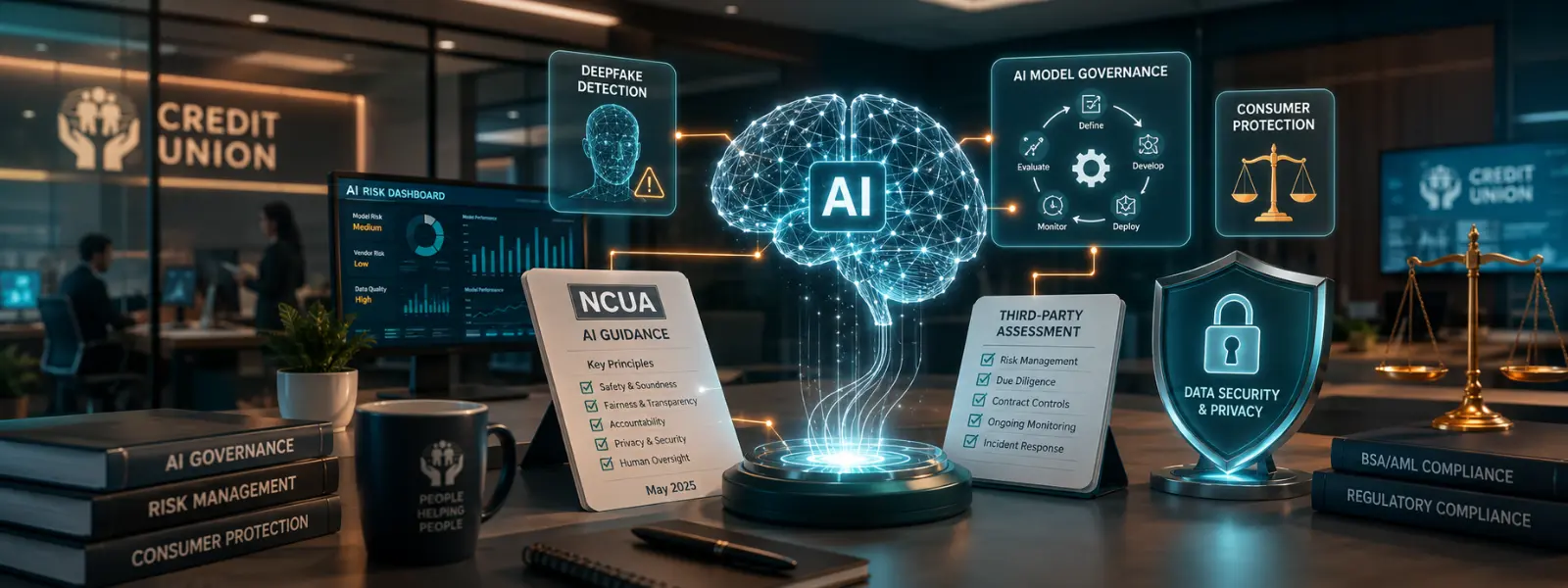
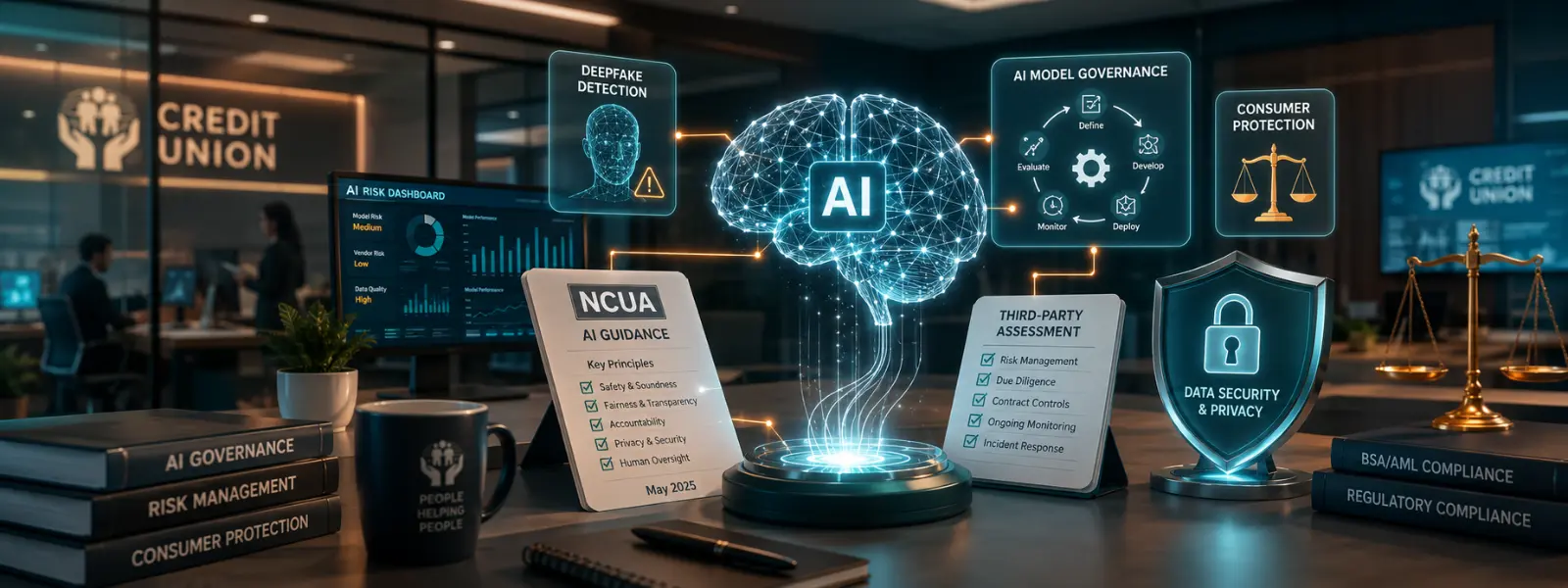
The NCUA has used its AI resources to point credit unions back to existing oversight disciplines, including information security, third-party risk management, and governance. The practical takeaway is that credit unions should not wait for a standalone AI rulebook before inventorying AI uses, assessing AI vendors, and documenting controls around data security, model reliability, and consumer impact.
For credit union leaders, this means the way to prepare for AI-related examination scrutiny is not to wait for an AI-specific rulebook. It is to apply your existing information security, third-party risk management, and governance frameworks to your AI activities now.
What the NCUA's AI Guidance Actually Says
The NCUA's updated AI resource page explicitly links AI oversight to two existing guidance documents: Letter to Credit Unions 07-CU-13 on evaluating third-party relationships and Letter to Credit Unions 01-CU-20 on due diligence over third-party service providers. If your credit union is using an AI vendor for fraud detection, member service, lending decisions, or operational efficiency, those vendors are third-party service providers subject to your existing vendor risk management obligations.
The NCUA also highlighted a CISA publication titled Deploying AI Systems Securely, which addresses methods for securely deploying and operating AI systems developed by external entities, including protecting model weights, implementing secure APIs, and establishing continuous monitoring protocols for AI systems in production. This guidance is directly applicable to credit unions using vendor-provided AI systems.
The Deepfake Fraud Risk the NCUA Specifically Flagged
The NCUA's updated AI guidance specifically highlighted a FinCEN report on fraud schemes involving deepfake media targeting financial institutions. Criminals are using AI-generated deepfakes to create fake identity documents, photographs, and videos to evade customer verification controls. For credit unions with digital member onboarding processes or remote account opening, this is a direct and current threat.
The FinCEN report outlines specific red-flag indicators of deepfake fraud activity and offers best practices for strengthening identity verification and reporting suspicious activity. Credit unions that have not reviewed their member identity verification controls against these red flags should do so.
AI Data Security: A New Examination Focus
The NCUA's guidance included a CISA Cybersecurity Information Sheet specifically on AI data security, covering how to secure the data that powers AI systems. This includes data supply chain security, protection against maliciously modified data, and managing data drift to preserve the integrity and accuracy of AI-driven decisions.
For credit unions using AI for fraud detection or member risk scoring, data integrity is not just a technical concern. If the data used to train or operate an AI model is compromised or drifts in ways that affect model accuracy, the model's outputs may create compliance risk , including fair lending concerns if the degraded model makes decisions that disproportionately affect protected classes.
The NCUA's updated AI guidance signals that supervisory expectations around AI will be grounded in existing, well-known frameworks rather than a bespoke AI rulebook. The practical implication is that examiners will assess your AI activities through the lens of information security, third-party oversight, and safety-and-soundness disciplines they already apply. If your existing programs are strong, your AI governance will follow from them.
What Credit Unions Should Do Now
The practical steps for credit unions that want to be prepared for AI-related examination scrutiny are straightforward extensions of existing program requirements.
First, inventory every AI system or AI-enabled vendor you use. This includes fraud detection systems, member service chatbots, lending decision tools, and any operational automation that uses machine learning or AI. For each one, verify that your standard vendor due diligence process has been applied and that the vendor relationship is documented in your vendor risk management program.
Second, review your member identity verification controls against the FinCEN deepfake red flags. If you have a digital onboarding process, assess whether your current controls would detect AI-generated fake identity documents.
Third, ensure your board cybersecurity training , , includes a discussion of AI-specific risks relevant to your credit union's operations.
The credit unions that will navigate AI-related examination scrutiny most effectively are not the ones that wait for specific AI regulations to arrive. They are the ones that apply their existing governance and risk management frameworks to AI activities now, before an examiner asks whether they have.