Abrigo's Sageworks Was Down for Three Days. This Vendor Outage Likely Meets the Bank Notice Trigger. The Finzly Listing Likely Did Not.
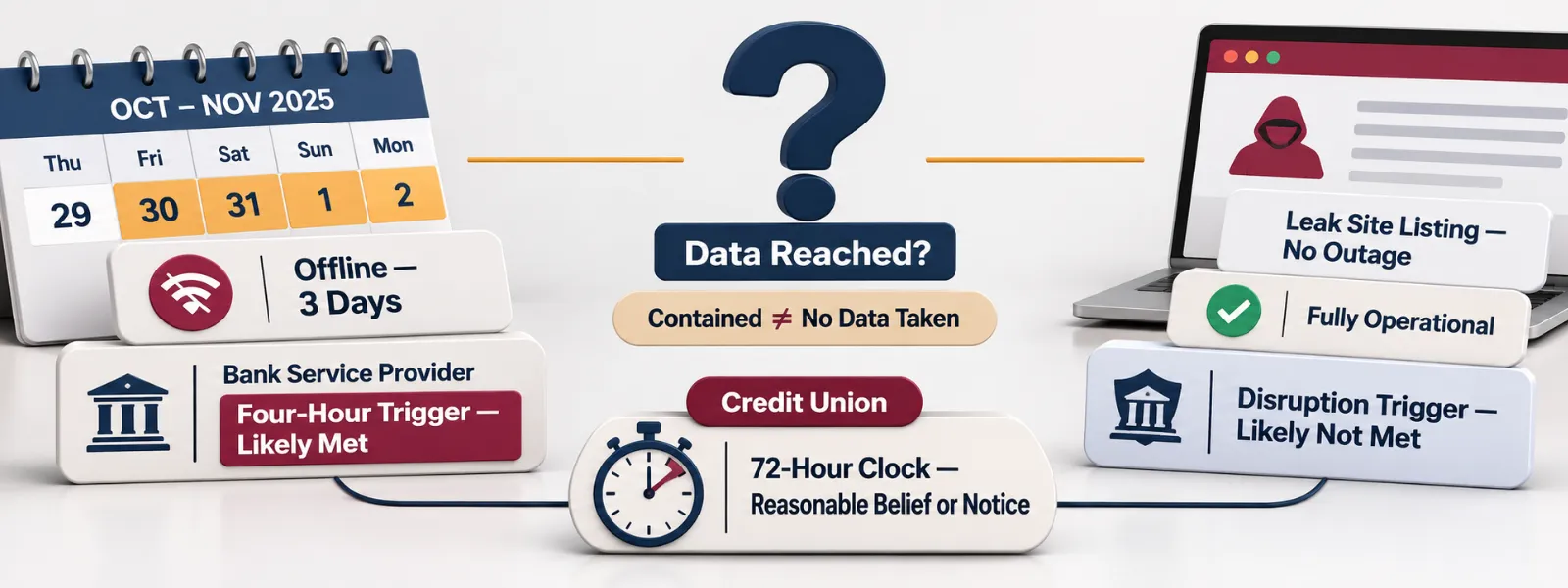
On Friday, October 30, 2026, Abrigo disabled its Sageworks platform before 11:30 a.m. Eastern after detecting what its status page called irregular activity. Sageworks is lending and credit analysis software used by banks and credit unions, mainly for commercial and small-business loans.
Most of the platform came back early Monday, November 2. Borrower-facing features were still offline on Tuesday.
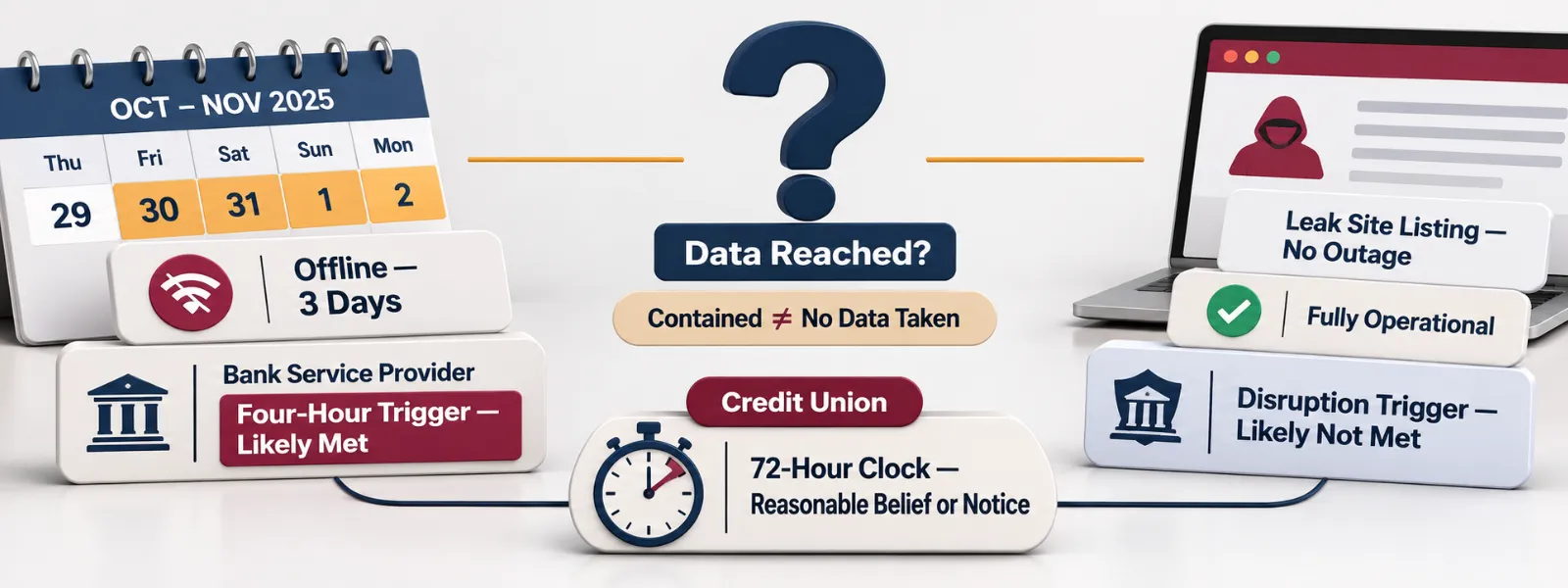
Abrigo later told American Banker it was "a recent data security incident related to our Sageworks platform" and that the unauthorized access had been contained. It did not say whether any data was taken.
Two weeks ago, a different vendor story looked similar on the surface. The extortion group n0n listed payments vendor Finzly on its leak site, while Finzly said it was fully operational. The two events land very differently under the federal notification rules, and the difference is worth understanding before the next one.
What is known about the Sageworks incident
Three products were affected, according to American Banker and eSecurity Planet: Sageworks Analyst, Sageworks API, and Online Portal Now, which borrowers use to submit loan applications.
Abrigo's product page describes Sageworks as holding loan documents, including borrowers' tax returns, financial statements, rent rolls, and credit reports.
Abrigo says more than 2,400 institutions use its products. That figure covers all of its software, not Sageworks alone. Abrigo has not said how many institutions use Sageworks.
This is the third Abrigo-related incident in about 14 months. In August 2025, attackers reached its Salesforce account through a compromised Drift integration. In April 2026, ShinyHunters reportedly attempted an extortion, and Have I Been Pwned lists more than 700,000 email addresses from that data.
As of November 9, Abrigo had not confirmed whether data was taken in the Sageworks incident. A class action site tracking the matter lists the affected data as to be determined.
Why this one likely meets the bank trigger
The federal computer-security incident notification rule, 12 CFR Part 53 for the OCC with parallel Federal Reserve and FDIC rules, puts a duty on bank service providers.
A bank service provider must notify affected banking customers as soon as possible when it determines it has experienced a computer-security incident that has materially disrupted or degraded, or is reasonably likely to materially disrupt or degrade, covered services for four or more hours.
Sageworks went down on a Friday morning and did not fully return until Monday, with borrower features out longer. A multi-day outage of the platform banks use to analyze and process commercial loans is the kind of event the four-hour trigger describes.
The bank's own clock is separate. A banking organization notifies its primary federal regulator within 36 hours of determining that a notification incident occurred, meaning a computer-security incident that materially disrupted or degraded, or is reasonably likely to materially disrupt or degrade, specified operations.
Whether a Sageworks outage reached that level for your bank depends on how much of your lending runs through it.
The contrast with Finzly
Finzly was named on a leak site, with claims of stolen payment access keys, while it stated it was fully operational. Both bank-side triggers turn on disruption or degradation, actual or reasonably likely. A data theft claim with no outage may not obligate a service provider to call its bank customers at all.
Abrigo is the opposite case. The disruption is visible and documented. The open question is the data.
That difference shapes the questions you ask. With Finzly, the question was whether anything had happened at all. With Abrigo, something clearly happened. The questions are what was reached, whether your institution's borrower files were part of it, and whether the vendor's notice to you met the service provider duty. A vendor's notice to its banking customers is not something you file away. Its timing is evidence in your own determination.
Credit unions run a different clock
For federally insured credit unions, 12 CFR 748.1(c) covers more than disruption. It applies to a substantial cyber incident that leads to one of three outcomes.
Prong (C) of the reportable cyber incident definition covers a disruption of business operations or unauthorized access to sensitive data caused by a compromise of a credit union service organization, cloud service provider, or other third-party data hosting provider, or by a supply chain compromise.
The 72-hour clock runs from the credit union's reasonable belief, or from notice by a third party under prong (C), whichever comes first.
For a credit union using Sageworks, the live question today is the disruption. Abrigo has confirmed unauthorized access to its environment, not access to sensitive data. If Abrigo later confirms that borrower or member data was reached, prong (C)'s sensitive data path would come into play. Either way, the incident must rise to a substantial cyber incident for the credit union, which depends on how it used the platform and what it learns.
Contained is not the same as "no data taken." Abrigo has confirmed unauthorized access and has not said whether borrower documents were reached. Your reporting analysis, and your borrower notice analysis, should rest on a written answer from the vendor, not on the word "contained."
What to do
Confirm whether you use Sageworks, including through a loan origination or credit platform that embeds it.
Find Abrigo's notice to you. If you received one, record when. If you did not receive one, ask why, and record that too.
Ask Abrigo in writing whether borrower documents tied to your institution were accessed or taken, which products were in scope, and whether credentials or API connections to your systems need rotation.
Rotate Sageworks API credentials and any integration secrets from your side.
Document your determination. Banks should record whether the outage met the notification incident standard for their operations. Credit unions should record when the 72-hour clock started or why it did not.
Revisit Abrigo's vendor risk rating. Three incidents in about 14 months is relevant history for any vendor risk assessment.
Check your borrower obligations. If commercial borrowers' tax returns or financial statements were reached, state breach laws and your contracts may require notice. Work through that with counsel.
Re-check the facts. Abrigo's investigation is ongoing, and facts may change after this was written.
SOURCE: 12 CFR Part 53 (OCC), 12 CFR Part 225 Subpart N (Federal Reserve), and 12 CFR Part 304 Subpart C (FDIC). 12 CFR 748.1(c). Incident facts from American Banker, "Abrigo confirms 'data security incident' caused 3-day outage," November 3, 2026; eSecurity Planet, November 3, 2026; Abrigo status page updates.
This article is provided for general information and does not constitute legal advice. Regulatory requirements, compliance dates, examiner priorities, and enforcement posture change frequently. Verify current requirements against primary agency sources and your legal counsel before acting on anything described here.